
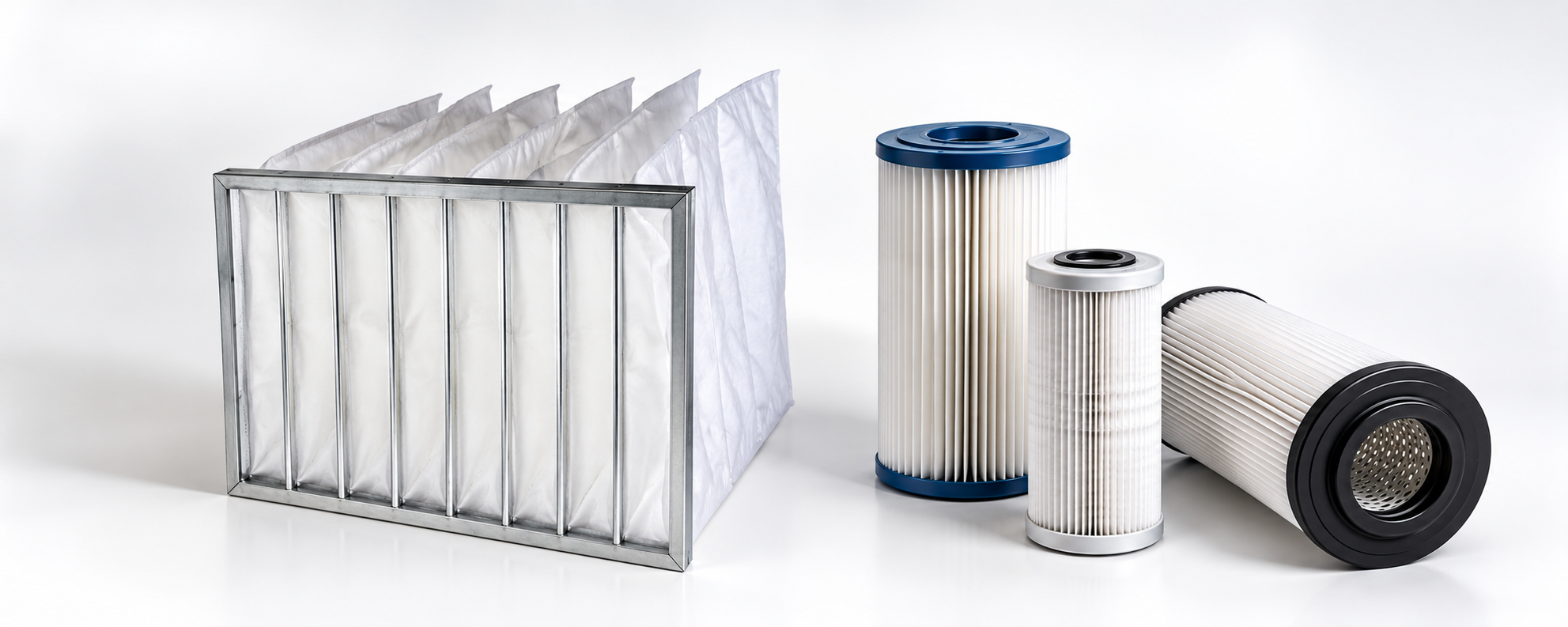
Choosing between a bag filter and a cartridge filter comes down to what your liquid filtration system needs to remove, how much liquid it needs to process, and how often the filter will need to be replaced.
Both options can provide effective industrial liquid filtration, but they differ in dirt-holding capacity, filtration precision, flow rates, maintenance, and operating costs.
Here’s how bag filters and cartridge filters compare, and how to determine which one makes sense for your process.
Bag Filter vs. Cartridge Filter at a Glance
| Factor | Bag Filter | Cartridge Filter |
|---|---|---|
| Typical use | Coarse to medium filtration | Fine to very fine filtration |
| Dirt-holding capacity | Generally high | Varies by cartridge type |
| Flow rates | Well suited to high-flow applications | Standard and high-flow options available |
| Filtration ratings | Available in various micron ratings | Wide range of micron ratings |
| Maintenance | Quick bag replacement | Quick cartridge replacement |
| Common role | Prefiltration and particle removal | Fine filtration and polishing |
The right choice depends on the specific liquid, particle load, flow rate, and filtration target.
What Is a Bag Filter?
A bag filter uses a flexible filter bag installed inside a filter housing. As liquid flows through the bag, suspended particles are captured by the filter media.
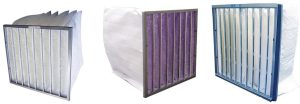
A single bag filter housing is one common configuration, although industrial systems can use different housing designs depending on flow requirements and the number of filter bags needed.
Bag filters are commonly used when a process produces a relatively high particle load or when larger amounts of contaminant need to be removed before a finer filtration stage.
They can be useful for:
- Removing suspended solids
- Prefiltering process liquids
- Handling higher dirt loads
- Protecting downstream filtration equipment
- High-flow liquid filtration
Bag filters are available in different materials and micron ratings, so the bag itself needs to be selected based on the liquid and the particles being removed.
What Is a Cartridge Filter?
A cartridge filter uses a cylindrical filter element installed inside a cartridge housing. The cartridge media captures particles as liquid passes through it. 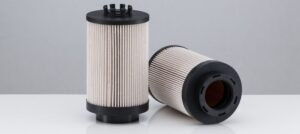
Cartridges are available in a wide range of designs and filtration ratings, making them suitable for applications that require more precise particle removal.
Cartridge filters are commonly used for:
- Fine particle removal
- Final filtration
- Product polishing
- Protecting sensitive downstream equipment
- Applications requiring specific filtration ratings
As with bag filters, the cartridge material, construction, and micron rating should match the process requirements.
Bag Filter vs. Cartridge Filter: What’s the Difference?
The biggest differences come down to particle loading, filtration requirements, flow rate, and operating costs.
1. Filtration Precision
Cartridge filters are often selected when a process requires fine or consistent particle removal. They are available in many filtration ratings and media configurations.
Bag filters can also be manufactured for different micron ratings, so the choice should be based on the actual filtration requirement rather than assuming one filter type is always more precise.
If the goal is to remove very small particles before a final process stage, a cartridge filter may be more appropriate.
2. Dirt-Holding Capacity
The amount and type of contamination in the liquid can have a major effect on filter life.
Bag filters can be a practical choice for applications with heavier dirt loads. A heavily contaminated process can quickly load a fine filter, making prefiltration useful.
Cartridge dirt-holding capacity varies considerably depending on the cartridge design and media.
3. Flow Rate
Flow requirements also affect filter selection.
A system processing large volumes of liquid may require a larger housing, multiple filter elements, or a high-flow filtration design.
Both bag and cartridge systems can be configured for higher flow rates, so the appropriate option depends on the required flow, available space, pressure drop, and filter configuration.
4. Operating Cost
The purchase price of a filter element is only one part of the cost.
When comparing bag filters and cartridge filters, consider:
- Element cost
- Replacement frequency
- Labor
- Disposal
- Downtime
- Pressure drop
- Energy requirements
A less expensive filter element may not provide the lowest overall operating cost if it needs to be replaced frequently.
5. Maintenance
Both systems are designed for relatively straightforward element replacement.
The actual maintenance requirements depend on the housing design, installation, and process conditions. Operators should also monitor pressure drop and flow performance to determine when an element needs to be changed.
6. Chemical and Temperature Compatibility
Filter selection goes beyond choosing a bag or cartridge.
The filter media must be compatible with the liquid, operating temperature, pressure, and chemicals present in the process.
The materials used in industrial filters can vary significantly, so material compatibility should be evaluated before selecting an element.
For example, a filter material that works well with water may not be appropriate for an aggressive chemical solution.
When Should You Use a Bag Filter?
A bag filter may be a good fit when your process requires:
- High dirt-holding capacity
- Removal of larger suspended particles
- High-volume liquid filtration
- Prefiltration before a finer filter
- Frequent contamination that would quickly load a fine filter
Bag filters can be particularly useful as the first filtration stage when a process contains a significant amount of suspended material.
When Should You Use a Cartridge Filter?
A cartridge filter may be a better fit when your process requires:
- Fine particle removal
- More precise filtration
- Final product polishing
- Protection for sensitive downstream equipment
- A specific micron rating or filter media
Cartridge filters are often used further downstream when the liquid has already passed through a coarser filtration stage.
Can You Use Bag and Cartridge Filters Together?
Yes. Using both can provide a multi-stage filtration approach.
For example:
The bag filter handles a larger particle load first, while the cartridge provides finer filtration afterward.
This type of setup is an example of a multi-stage industrial filtration system, where different filtration stages work together to achieve the desired level of particle removal.
Using a coarse filtration stage before a finer one can help prevent the cartridge from loading prematurely, potentially extending cartridge life and reducing replacement frequency.
The exact setup depends on the contaminant load, target particle size, flow rate, and required final filtration level.
Bag vs. Cartridge Filter: Which Should You Choose?
There isn’t one filter type that works best for every industrial liquid filtration application.
Consider a bag filter when your priority is handling higher dirt loads, removing larger particles, or providing economical prefiltration.
Consider a cartridge filter when you need finer particle removal, specific filtration performance, or final polishing.
For some processes, using both provides the most practical approach.
Before selecting a filter, evaluate:
- Liquid: What fluid are you filtering?
- Contaminants: What type and concentration of particles are present?
- Flow rate: How much liquid must the system process?
- Micron rating: What particle size needs to be removed?
- Operating conditions: What are the temperature and pressure?
- Compatibility: Is the filter media compatible with the process fluid?
- Operating cost: How frequently will the elements need to be replaced?
For a broader look at the factors involved in selecting an industrial filtration solution, see How to Choose the Right Filtration System for Your Industry.
Getting these details right can help prevent premature filter loading, unnecessary replacement costs, and inadequate filtration.
Frequently Asked Questions
Is a bag filter better than a cartridge filter?
It depends on the application. Bag filters can be well suited to higher dirt loads and prefiltration, while cartridge filters are often selected for finer filtration and polishing.
What is the difference between a bag filter and a cartridge filter?
A bag filter uses a flexible filter bag, while a cartridge filter uses a rigid cylindrical filter element. Both are installed in housings and available with different filter media and micron ratings.
Which has a higher dirt-holding capacity?
Dirt-holding capacity depends on the specific filter design and media. Bag filters are commonly used in applications with higher contaminant loads, while cartridge capacity varies significantly between cartridge types.
Can a bag filter and cartridge filter be used together?
Yes. A bag filter can be used as a prefilter before a cartridge filter to remove larger particles and reduce the contaminant load reaching the finer filtration stage.
How do I choose the right industrial liquid filter?
Start with the liquid, contaminant type, particle size, flow rate, temperature, pressure, chemical compatibility, and required filtration level. These factors will help determine the appropriate filter type, media, micron rating, and housing configuration.
Need Help Choosing a Filter?
The right filtration system depends on your process conditions and performance requirements.
Advanced Filtration can help you evaluate your application and determine the appropriate filtration solution based on factors such as flow rate, particle loading, micron rating, filter media, and chemical compatibility.